
TRIVANDRUM, INDIA – JANUARY 12: Woman sitting in a hammock and working with a notebook on January … [+]
Getty Images
Golf is hard. Investing should’t be.
A simple portfolio of a few low-cost index funds is likely to outperform the most complicated, expensive investment products on Wall Street. Called Lazy Portfolios, these investment strategies work if you have $100 or $100 million to invest. They also work if you are 50 years from retirement or already enjoying your golden years.
There are dozens of Lazy Portfolios. In this article we’ll look at three of the most popular ones. For each portfolio I’ll include the Compound Annual Growth Rate (CAGR) using Portfolio Visualizer. The performance data covers January 2010 to May 2021, an important limitation we’ll return to in a minute. I’ll also include how long it would take to become a millionaire at that rate assuming one maxed out an IRA ($6,000 in 2021).
3-Fund Portfolio
By far the most popular, the 3-fund portfolio is all that a future millionaire needs. As the name suggests, it consists of just three asset classes:
- U.S. Stocks
- U.S. Bonds
- International Stocks
How much an investor allocates to each asset class will depend on their risk tolerance and investing time horizon. For long-term investors, an allocation of 55% U.S. stocks, 35% international stocks, and 10% U.S. bonds is a reasonable approach, but certainly not the only one.
Investors can implement the 3 fund portfolio with index mutual funds or ETFs from a variety of fund providers. Here are a few examples:
Vanguard
- Vanguard Total Stock Market Index Fund (VTSAX)
- Vanguard Total International Stock Index Fund (VTIAX)
- Vanguard Total Bond Market Fund (VBTLX)
Fidelity
- Fidelity Total Market Index Fund (FSKAX)
- Fidelity Total International Index Fund (FTIHX)
- Fidelity U. S. Bond Index Fund (FXNAX)
CAGR: 10.68%
Time to Millionaire (TTM): 28 years
Paul Merriman Portfolio
My friend Paul Merriman has constructed what he calls the Ultimate Buy & Hold Portfolio. For equities, it consists of 10 asset classes. Yes, that’s a lot, although implementing it with a broker like M1 Finance makes managing the portfolio very easy. Here are the 10 asset classes:
- S&P 500
- U.S. Large Cap Value (LCV)
- U.S. Small Cap Blend (SCB)
- U.S. Small Cap Value (SCV)
- Real Estate Investment Trust (REIT)
- International Large Cap Blend (LCB)
- International LCV
- International SCB
- International SCV
- Emerging Markets
Note that the equity portfolio is weighted heavily with international stocks, small cap stocks, and value stocks. Historically, small cap and value have performed extremely well. In the last decade, however, large cap growth stocks have been the leaders.
As such, over the time period measured for this article, the portfolio has lagged a bit. Over longer periods of time, say the past 5 decades, the strategy has performed extremely well. I calculated the performance without any exposure to bonds, although bonds should be added as an investor’s risk tolerance and time to retirement dictate.
CAGR: 10.08%
TTM: 29 years
Warren Buffett Portfolio
Finally, the Warren Buffett Portfolio embodies Steve Jobs’ philosophy that simplicity is the ultimate sophistication. It consists of just two asset classes: an S&P 500 index fund and a short-term U.S. government bond fund.
This portfolio comes from Mr. Buffett’s 2013 letter to Berkshire shareholders. After noting that paid money managers aren’t worth the cost, he described the instructions he has given the trustees on managing money he’ll leave to his wife:
My advice to the trustee could not be more simple: Put 10% of the cash in short-term government bonds and 90% in a very low-cost S&P 500 index fund. (I suggest Vanguard’s.) I believe the trust’s long-term results from this policy will be superior to those attained by most investors – whether pension funds, institutions or individuals – who employ high-fee managers.
This simple portfolio has outperformed the others over the past decade.
CAGR: 13.25%
TTM: 24 years
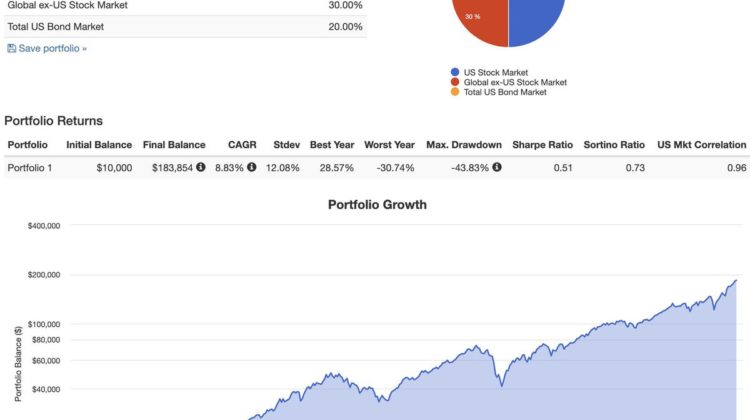
Here’s a snapshot of each portfolio’s performance:
Performance of Lazy Portfolios
Portfolio Visualizer
Keep in mind that the last decade has seen large growth companies outperform other parts of the market. That’s certain to change. When it does, Paul Merriman’s portfolio could easily outperform the Warren Buffett portfolio over a period of time. At other times the 3-fund portfolio will outperform.
Further, there are other lazy portfolios worth considering, such as the David Swensen Portfolio or the Ray Dalio Portfolio. The key is that any of the above Lazy Portfolios should be a core part of a long-term, buy and hold investing strategy.