
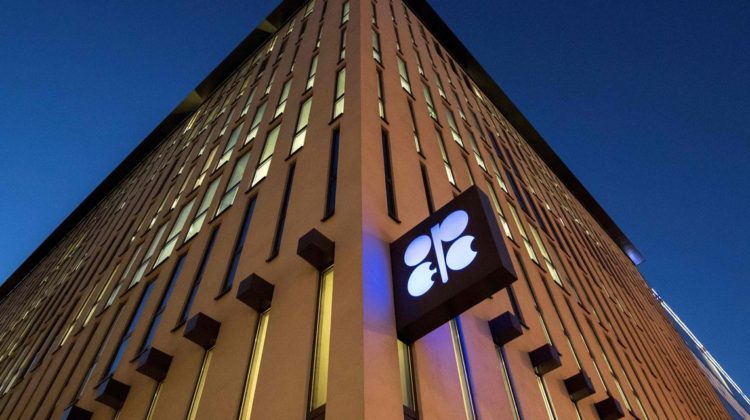
It was obvious that the Organization of the Petroleum Exporting Countries and their allies, collectively known as OPEC+, would have a difficult time reaching a decision on oil production levels in the new year when the group postponed its meeting this week.
The big surprise, however, may be that oil prices haven’t plunged, even as news emerges that the producers have agreed to increase output at the start of 2021.
In Thursday dealings, January West Texas Intermediate crude
CLF21,
CL.1,
was up 31 cents, or 0.7%, at $45.59 a barrel on the New York Mercantile Exchange. February Brent crude
BRNG21,
added 40 cents, or 0.8%, to $48.65 a barrel on ICE Futures Europe.
At a meeting Thursday, which had been originally scheduled for Tuesday, OPEC+ agreed to raise their collective production by 500,000 barrels a day in January, according to The Wall Street Journal, citing comments from people familiar with the matter. That would be followed by further output hikes in subsequent months, the report said. OPEC+ hasn’t yet official made the announcement on its decision.
Ahead of the meeting, the market had expected OPEC+ to reach a deal to extend the current output cuts of 7.7 million barrels per day into the new year. The group was due to relax the reductions though to 5.8 million barrels a day at the start of 2021 through the end of April 2022.
In a tweet, Amena Bakr, deputy bureau chief and chief OPEC correspondent at Energy Intelligence, said that after the 7.7 million barrels per day in output cuts are eased by 500,000 barrels per day in January, ministers will hold meetings to see if another 500,000 barrels per day could be added until 2 million barrels per day is reached.
That suggests a more gradual output climb in output, smaller than the previously planned increase of close to 2 million barrels per day that would’ve started in January, but the decision was not easily reached.
“Negotiations
among OPEC+ members is reminiscent of textbook game theory at work — the
group as a whole benefits if it agrees to make cuts, but each individual members
would prefer if someone other than itself made the cuts,” Manish Raj, chief
financial officer at Velandera Energy, told MarketWatch. “Kazakhstan, Iraq,
Nigeria and Russia are notorious for agreeing to cuts, but not honoring them.”
He referred to a “massive” surplus production capacity as a “lingering headache” for OPEC+. “At least 12 million barrels per day of capacity can be brought online if all producers were allowed to produce at will,” so it’s “no surprise that long term oil futures, dating all the way up to the year 2030, are trading below the present market prices, on the back of excess capacity among oil producers.”
“OPEC members are aware that no reasonable demand scenario exists that will consume such volume of oil in years to come, therefore, they realize that they must either put up with low prices, or be constrained by ongoing production cuts,” said Raj.
He believes that “unlike in previous meetings, when OPEC+’s policy revolved around rising American production, the present meetings are focused on long term sustainability of oil markets.”
Concerns surrounding weakness in energy demand resulting from restrictions on consumer and business activity, implemented to stem the spread of COVID-19, have been a key issue.
“Demand recovery has lagged, and everyone has been anxious for some time to get back to pre-COVID production levels and generate more revenue,” said Andy Brogan, global oil and gas leader at Ernst & Young, in emailed commentary.
“In times like these, no one wants to make a disproportionate sacrifice,” he said. “Unfortunately after this much pain, any sacrifice starts to seem disproportionate. Pressure to increase production will be relentless.”
OPEC+ has also had problems getting certain countries to comply with current production cuts, and had been pushing for those nations to compensate for prior overproduction.
“This has become one of the thornier issues this year, and the market will be looking to see how this gets resolved,” said Peter McNally, global sector lead at Third Bridge for industrials, materials and energy.
An S&P Global Platts survey released in early November revealed that OPEC+ oil output rose by 210,000 barrels per day in October to 37.27 million barrels per day.
The big question is whether that the 500,000 barrel-per-day increase “includes a commitment by past OPEC cheaters to compensate for over production,” Phil Flynn, senior market analyst at The Price Futures Group, told MarketWatch.
“If cheaters have to compensate, then this production increase will be negligible — just moving barrels around from one producer to another,” he said.
As far as market actions, oil prices are modestly higher, he said. It “does not hurt that the U.S. dollar
DXY,
is at a two-and-a-half year low and there’s renewed talk of U.S. coronavirus aid package, said Flynn. “That makes it easier for nervous bulls to hang tough.”